
The numbers show Page has long reached a global audience
There is no regularly published, audited breakdown of domestic and international visitors specifically for Antelope Canyon. The best local comparison comes from a Northern Arizona University survey of visitors to Page conducted in 2014 and 2015. In that survey, 43% of respondents were international visitors and approximately 57% were domestic visitors. Germany represented 16% of the international sample, followed by Canada at 13%, Italy at 12% and the United Kingdom at 11%.
That local result stands out against a newer statewide benchmark. The Arizona Office of Tourism reported that Arizona’s 2025 visitation was 88% domestic and 12% international. The two studies cover different places and years, so they should not be treated as a direct trend line. Together, however, they support a clear conclusion: Page and its signature landscapes have historically attracted an unusually international mix of travelers compared with Arizona overall.
A landscape that does not resemble anywhere else
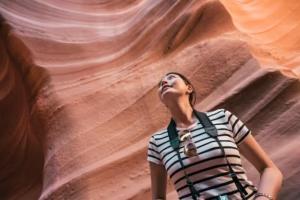
Upper Antelope Canyon is a slot canyon, formed as rushing water and wind worked through sandstone over time. Its Navajo name, Tsé bighánílíní, is commonly translated as “the place where water runs through rocks.” The canyon’s narrow shape allows sunlight to enter from above and bounce between the walls, creating intense color and contrast.
Visitors do not simply look across the canyon from an overlook. They move through it at ground level, surrounded by stone. That close, immersive scale is one reason the experience feels so different from seeing a wide canyon or distant mountain range. Every turn introduces another shape, and even a short change in the sun can transform the same wall.
Photography made the canyon instantly recognizable
Antelope Canyon became one of the world’s most recognizable natural settings through travel magazines, fine-art photography, calendars, advertising and social media. Its curves are easy to identify but difficult to summarize in a single frame. Visitors arrive after seeing the canyon for years, then discover that it looks different in person because the light and color are constantly changing.
The canyon welcomes experienced photographers and first-time visitors alike. A modern phone can record remarkable color, but the most meaningful photographs often come from understanding the space rather than taking as many images as possible. Local guides help guests see compositions, navigate the canyon respectfully and remain aware of the group and surrounding conditions.
A guided experience rooted in place
Antelope Canyon is on Navajo Nation land, and visitors must enter with an authorized tour operator. This requirement is more than a logistical detail. A Navajo-guided tour connects the physical beauty of the canyon with the people, history and living culture of the land.
For international travelers—and for Americans visiting the Southwest for the first time—that context makes the experience more complete. The canyon is not an anonymous backdrop. It is part of a homeland. Listening to a guide, following site rules and treating the canyon with care are essential parts of visiting responsibly.
A natural stop on a Southwest journey
Page is positioned near several destinations that appear on travelers’ lifetime lists. A trip may connect Antelope Canyon with Horseshoe Bend and Lake Powell, then continue to Monument Valley, the Grand Canyon, Zion or Bryce Canyon. That location makes the canyon accessible within a larger road trip while still offering an experience unlike the surrounding parks and overlooks.
Its appeal also crosses language and age. The visual impact is immediate, the guided format helps visitors understand what they are seeing, and the walk through Upper Antelope Canyon is compact enough to fit into many itineraries. Families, photographers, couples and tour groups may arrive for different reasons, but they share the same sense of discovery inside the canyon.
The canyon keeps changing
Water created Antelope Canyon, and water continues to reshape it. Sand shifts across the floor. Edges soften. Storms alter familiar details. The light changes by season, hour and cloud cover. Even travelers who have memorized photographs cannot predict exactly what the canyon will look like during their visit.
That element of change is the heart of its worldwide appeal. Antelope Canyon is famous, yet no visit can be completely reproduced. The view belongs to that moment—and the best way to understand it is to stand inside the canyon with a Navajo guide.
Plan your visit with Antelope Canyon Navajo Tours and experience Upper Antelope Canyon with local guidance, cultural context and respect for the land.